
Summary
Small contractor proposal teams can use NAICS-based targeting and a weighted ranking workflow to prioritize government opportunities faster. By aligning internal capabilities with specific industry codes and automated tracking, teams move from reactive searching to proactive, high-probability bidding. NAICS is the manual foundation; meaning-based scoring is what takes it further.
1. The Strategic Foundation: Beyond Your Primary Code
Most small teams stop at their primary NAICS code (e.g., 541511 for Custom Computer Programming). In 2026, agencies are increasingly using “niche” secondary codes to hit specific small business goals.
- Audit your codes. Ensure your SAM.gov profile includes secondary codes that reflect your evolving capabilities (e.g., adding 541512 for Computer Systems Design if you’ve moved into AI integration).
- The 80/20 rule. Identify the 20% of NAICS codes that account for 80% of your target agency’s spending. In California, check the DGS eProcurement portal to see which codes are trending for SB/DVBE set-asides.

2. The NAICS-Driven Ranking Workflow
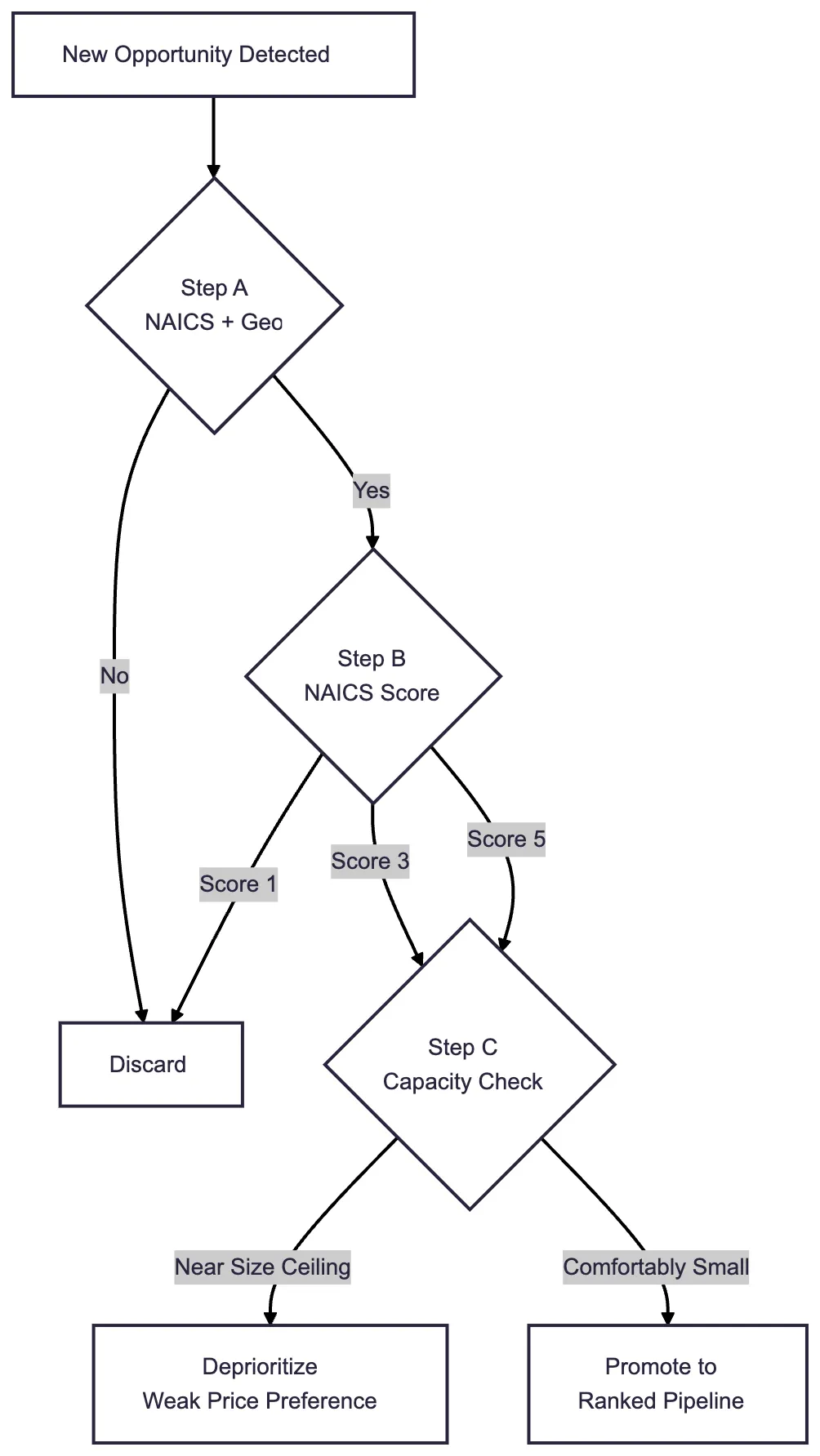
A small team cannot afford to read every RFP. Use this three-step workflow to rank opportunities before you open the Statement of Work.
Step A: The “Hard” Filter
Set up automated alerts (on SAM.gov or Cal eProcure) that filter by NAICS + Geography + Set-Aside Status. In 2026, California has expanded local preference programs, so a bid matching both your NAICS and your specific county should immediately bump to “Tier 1.”
Step B: The Scoring Matrix
Assign a numerical value (1–5) based on NAICS alignment:
- Primary NAICS (Score 5): Direct hit on your core expertise.
- Secondary NAICS (Score 3): You can do the work, but might need a subcontractor.
- Unfamiliar NAICS (Score 1): High risk; likely a “No-Go.”
Step C: The Capacity Check
Before committing, check the 2026 SBA Size Standards for that NAICS. If recent growth puts you near the “graduation” ceiling, the competitive landscape changes. Focus on codes where your “Small Business” status gives the steepest price preference.
3. Implementing the “Fast-Fail” System
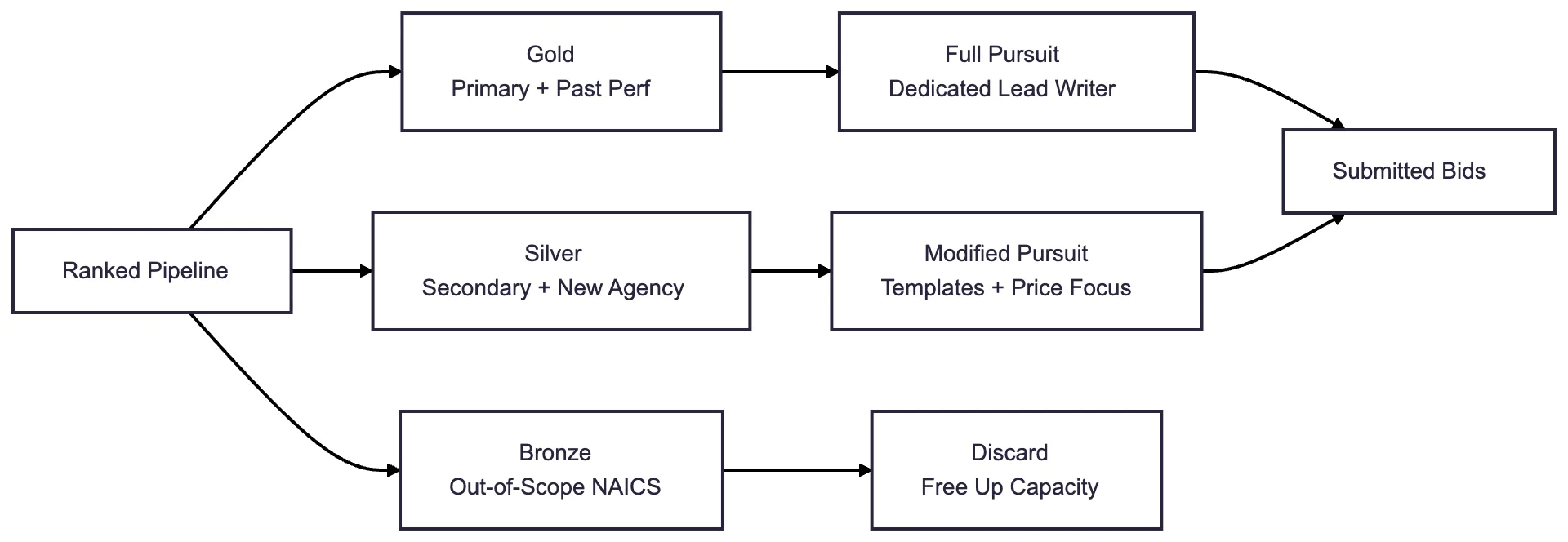
Small teams often fall into “sunk cost” bidding, continuing a proposal just because they started it. Use your NAICS ranking to fast-fail instead:
| Rank | NAICS Match | Action |
|---|---|---|
| Gold | Primary Code + Past Performance | Full Pursuit: dedicated lead writer. |
| Silver | Secondary Code + New Agency | Modified Pursuit: use templates; focus on price. |
| Bronze | Out-of-Scope NAICS | Discard: save resources for the next Gold lead. |
4. Where NAICS Ranking Falls Short
NAICS is the best free framework a small team can run by hand, but it ranks the label, not the meaning. One code covers dozens of unrelated services, so you get false matches, and a perfect opportunity that uses different wording never trips your filter at all. That blind spot is the most expensive one in bid triage: never seeing the contract you would have won.
This is exactly the gap meaning-based ranking closes. Instead of matching codes, it reads each solicitation and compares it to your real capabilities. (For the mechanics, see how bid ranking software calculates fit scores.)
Conclusion
In the 2026 contracting environment, data is your greatest leverage. A rigorous NAICS-based ranking system lets a small team stop “chasing” and start “capturing.” To remove the blind spots NAICS leaves behind, FindBids scores every active California bid against a plain-English profile of your business, so every hour you spend writing is an investment in an opportunity you are genuinely qualified to win.
Frequently Asked Questions
What is NAICS-based bid ranking?
It is a manual workflow that scores each opportunity by how closely its NAICS code matches your core capabilities, combined with geography, set-aside status, and capacity. It gives a small team a repeatable way to prioritize bids before reading a full Statement of Work.
Is NAICS enough to prioritize bids accurately?
It is a strong starting filter, but NAICS alone is noisy. One code can cover dozens of unrelated services, and a perfect-fit bid may use different words than your codes. Meaning-based (vector) ranking reads the actual solicitation, which is why many teams use NAICS to scope and an AI tool to score.
How do I find my best NAICS codes?
Audit your SAM.gov profile for secondary codes that reflect your current capabilities, then apply the 80/20 rule by focusing on the 20% of codes that drive 80% of your target agency's spending.